


© 2026 All rights reserved.

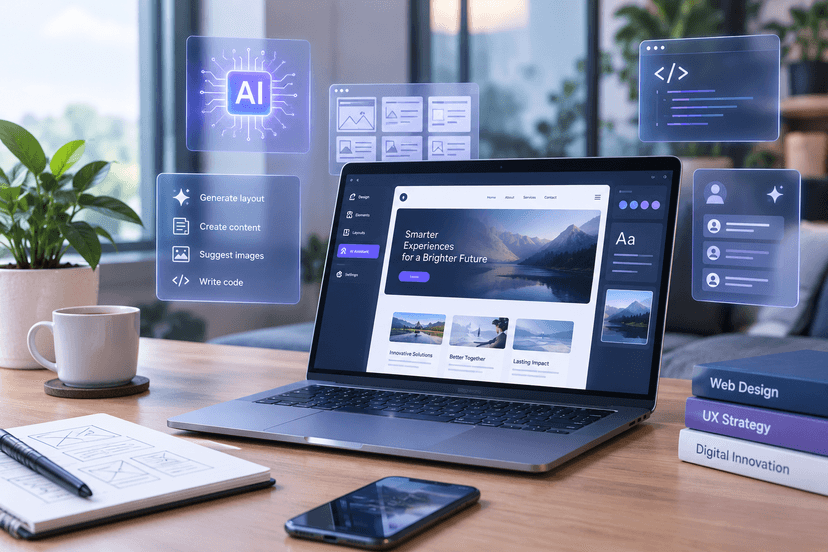
Artificial intelligence is changing the way businesses design, build, and manage websites. What once required hours of manual work can now be supported by AI-powered tools that help generate layouts, write content, create visual concepts, and improve user experiences.
In 2026, AI is becoming an increasingly important part of the web design process. However, the biggest opportunity is not simply creating websites faster. It is building websites that are more personalized, accessible, efficient, and aligned with business goals.
Whether you are a startup, a small business, or an established company, understanding how AI is transforming web design can help you make better decisions about your digital presence.
Traditionally, creating a website involves several stages, including research, planning, wireframing, visual design, development, testing, and optimization. AI tools can assist with many of these tasks, helping designers and developers work more efficiently.
For example, AI can help teams:
Generate initial website layouts and design concepts.
Create placeholder copy and suggest content structures.
Produce visual ideas based on a written description.
Assist with coding and identify potential errors.
Suggest improvements to existing pages.
Instead of starting with a blank page, designers can use AI-generated concepts as a starting point and refine them to match a brand's identity.
However, faster production does not automatically mean better design. Human expertise remains essential for choosing the right direction, ensuring consistency, and creating a website that meets real user needs.
Every visitor arrives at a website with different needs, interests, and expectations. AI can help businesses understand these differences and deliver more relevant experiences.
Depending on the available data and implementation, AI-powered websites can support personalized product recommendations, tailored content suggestions, intelligent search, and conversational assistance.
For example, an online store could recommend relevant products based on a visitor's browsing activity. A service-based business could use an AI assistant to help visitors find the right service or answer common questions.
Personalization can make websites more useful and engaging, but it must be implemented responsibly. Businesses should respect user privacy, follow applicable data protection requirements, and avoid collecting unnecessary personal information.
Content plays a major role in website performance. From landing pages and product descriptions to blog posts and frequently asked questions, businesses need clear, relevant information to communicate their value.
AI writing tools can support content creation by helping teams brainstorm topics, organize articles, develop first drafts, improve readability, and adapt messaging for different audiences.
AI can also help identify content gaps and suggest ways to improve existing pages.
However, publishing AI-generated content without reviewing it can create problems. Content may contain inaccurate information, repetitive language, or generic messaging that fails to reflect a company's expertise.
The best approach is to use AI as a writing assistant rather than a replacement for editorial judgment. Human review helps ensure that every page is accurate, distinctive, useful, and consistent with the brand's voice.
An effective website should be usable by as many people as possible, including visitors with disabilities.
AI-assisted tools can help teams identify potential accessibility issues, generate draft descriptions for images, improve content readability, and support automated testing.
These capabilities can make accessibility checks easier to integrate into the design and development process.
Nevertheless, automated tools cannot identify every accessibility problem. They may miss issues involving keyboard navigation, confusing interactions, screen-reader behavior, or the practical usability of a page.
Businesses should combine automated checks with manual testing and, where possible, feedback from people who use assistive technologies. Accessibility should be considered from the beginning of a project rather than added as an afterthought.
Search engine optimization remains an important part of helping customers discover a business online. AI can support SEO work by analyzing content, identifying related search terms, suggesting headings, organizing topic clusters, and helping teams improve page structure.
AI tools can also assist with writing title tags and meta descriptions, reviewing internal links, and identifying opportunities to update older content.
For example, a business that offers web design services could use AI to develop useful articles around website performance, user experience, responsive design, and website maintenance.
The goal should not be to publish as much content as possible. Instead, businesses should create reliable, original, and helpful resources that answer real questions.
AI-generated content still needs fact-checking, search intent analysis, and a clear editorial strategy. Search visibility depends on many factors, and using AI alone does not guarantee higher rankings.
Traditional chatbots often rely on fixed rules and predefined responses. More advanced AI assistants can interpret natural-language questions, retrieve relevant information, and help users navigate complex tasks.
On a business website, an AI assistant might help visitors:
Find information about products or services.
Understand pricing and service options.
Locate relevant articles or documentation.
Get answers to frequently asked questions.
Identify the appropriate next step, such as contacting the sales team.
Some systems can also connect with business software to perform specific tasks, provided they have the necessary integrations and permissions.
For businesses, the value of an AI assistant depends on the quality of its information and the tasks it can reliably handle. Clear limitations, appropriate human escalation, and regular monitoring are essential to avoid misleading answers or frustrating customer experiences.
Web design and web development have traditionally involved distinct but closely connected responsibilities. AI is helping bring these activities closer together.
Designers can use AI to explore alternative layouts, generate interface concepts, and test visual directions. Developers can use coding assistants to explain unfamiliar code, draft components, troubleshoot errors, and speed up repetitive implementation tasks.
This can improve collaboration and shorten the time between an initial idea and a working prototype.
However, AI-generated code still requires technical review. Security vulnerabilities, performance issues, accessibility problems, and compatibility errors can remain hidden even when a website looks correct.
Professional development practices—including testing, code review, version control, and security checks—remain important.
Launching a website is only the beginning. Businesses must also monitor performance and continuously improve the experience.
AI can help analyze website analytics, identify patterns in visitor behavior, summarize user feedback, and suggest areas for improvement.
For example, if visitors frequently leave a particular landing page, a team could investigate whether the content is unclear, the page loads slowly, or the next step is difficult to understand.
AI can help generate hypotheses and prioritize possible experiments, but the team should validate those suggestions using reliable data.
Useful performance indicators include:
Conversion rate.
Page loading speed.
User engagement.
Form completion rate.
Customer satisfaction.
Organic search traffic.
By combining AI-assisted analysis with real performance measurements, businesses can make more informed decisions about website improvements.
Although AI offers significant opportunities, adopting it without a clear strategy can create unnecessary complexity.
Generic design: AI-generated layouts may look similar to other websites. Strong branding, original creative direction, and thoughtful design decisions help businesses stand out.
Inaccurate content: AI may produce incorrect claims or outdated information. Important facts should always be verified before publication.
Privacy and security: AI tools may process sensitive business or customer data. Organizations should understand how their chosen tools handle information and apply appropriate security measures.
Accessibility and quality: Automated outputs can contain usability problems, inaccessible components, or technical errors that require human review.
Over-automation: Not every customer interaction or design decision should be automated. Human support and judgment remain valuable, particularly for complex or sensitive situations.
The most effective AI strategy balances automation with professional oversight.
Businesses do not need to redesign their entire digital presence to benefit from AI. A practical approach starts with identifying specific problems and testing suitable solutions.
Here are five steps to get started:
Step 1: Identify repetitive tasks. Look for activities such as drafting routine content, categorizing feedback, or answering common questions that could benefit from AI assistance.
Step 2: Choose tools that fit your workflow. Evaluate AI features based on their usefulness, security, integration options, cost, and ease of maintenance.
Step 3: Start with a small project. Test one application, such as an AI-assisted content workflow or website search assistant, before expanding to more complex use cases.
Step 4: Keep your brand identity consistent. Review AI-generated layouts, text, and images to ensure they reflect your brand's visual style, tone, and business goals.
Step 5: Measure the results. Compare the time required, quality of output, user satisfaction, and business outcomes before and after introducing AI.
This approach allows businesses to learn from real results instead of adopting new technology simply because it is trending.
AI is transforming web design by helping businesses create content, explore visual concepts, personalize user experiences, improve accessibility, and streamline development workflows.
Yet technology alone cannot create a successful website. A strong digital presence still depends on understanding customers, communicating a clear message, building trust, and delivering a reliable user experience.
In 2026, the most effective websites will combine AI's speed and analytical capabilities with human creativity, strategic thinking, and technical expertise.
For businesses planning a new website or improving an existing one, the opportunity is clear: use AI where it adds genuine value, maintain high standards of quality, and keep the needs of your audience at the center of every decision.
The future of web design is not simply about building websites faster. It is about building better digital experiences.
25 Oct 2026 • Content Team